



People ask billions of questions every day on Google. They look for things to purchase, services to hire, issues to resolve and businesses to trust. They hit the “Enter” button, and something happens: an algorithm scans hundreds of billions of Web pages in one instant and brings back information it thinks is most relevant.
So the big question for all business owners is: Is your website appearing in those results?
Otherwise, you’re neglecting one of the most effective and affordable marketing tactics of the day. The intangible force that decides who’s found and who’s ignored is called Search Engine Optimization (SEO), and knowing it may be the most crucial thing you do for your business’s digital future.
This guide will help you understand what SEO really is in the context of digital marketing, how it works, why it is important for businesses of all sizes and some of the things you can do to begin using SEO to your advantage.
What Is SEO? A Clear, Jargon-Free Definition
SEO (Search Engine Optimization) involves making your website better so search engines such as Google, Yahoo, and Bing show it in their organic search listings.
The word organic is very important! Organic traffic is earned traffic, unlike paid ads, which cost you a click. If Google really does value your information as valuable, reliable and relevant, then you gain free traffic as a result. Once a job is finished, it will keep giving back returns for a while.
Imagine if your business had a store location, signage, a warm welcome and a good reputation, and you could see how it would get people into your store, wouldn’t you? Online, they convert to content that’s relevant, technical, website performance, quality backlinks, and user trust signals.
SEO isn’t a “one and done” job. It is a continuous process that involves monitoring for content, technical health, user experience, and authority building, and requires all these components to work together to convey to the search engines that your website deserves to be at the top.
How Search Engines Actually Work
You need to know what search engines are trying to do in order to understand SEO.
Google is dedicated to organising the world’s information and making it universally accessible and useful. In actuality, this is their algorithm asking itself the question: “Which result will most please the individual who is typing the query right now?
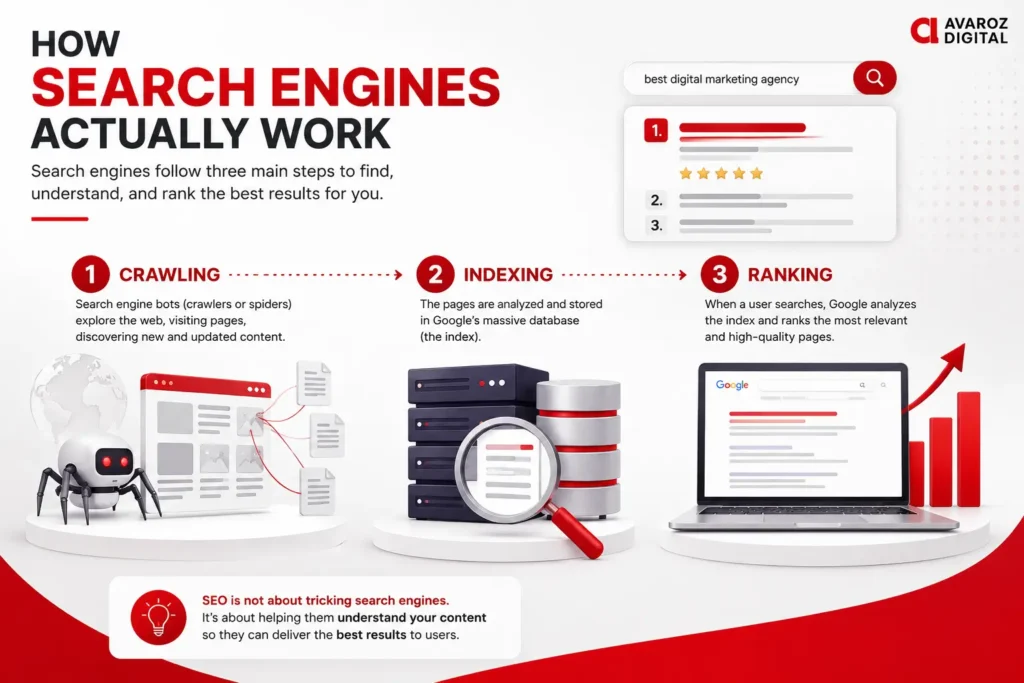
To make that determination, search engines use three core processes:
1. Crawling
Every day, search engine “bots” (often called “crawlers” or “spiders”) scour the web, visiting one page after another, finding new and updated content. If your site has broken links, a bad site structure or is accidentally blocking crawlers, Google might not discover your pages, not to mention rank them.
2. Indexing
Google crawls a page and then analyzes its content and stores it in a large database called the index. Google uses this as its search index when people enter a search request. Sometimes pages are thin on content, duplicate existing web pages or do not indicate clearly that they are relevant to the query and are therefore not included in the index.
3. Ranking
Google’s algorithm processes the query entered by the user, analyzing its index and ranking the relevant and quality pages. This is the part that’s really complicated. Google considers more than 200 known ranking factors and numerous others that are not public.
This process is key to the SEO process, which is not about “gaming” the system, but about helping search engines understand your content so that they can make it relevant to the right people.
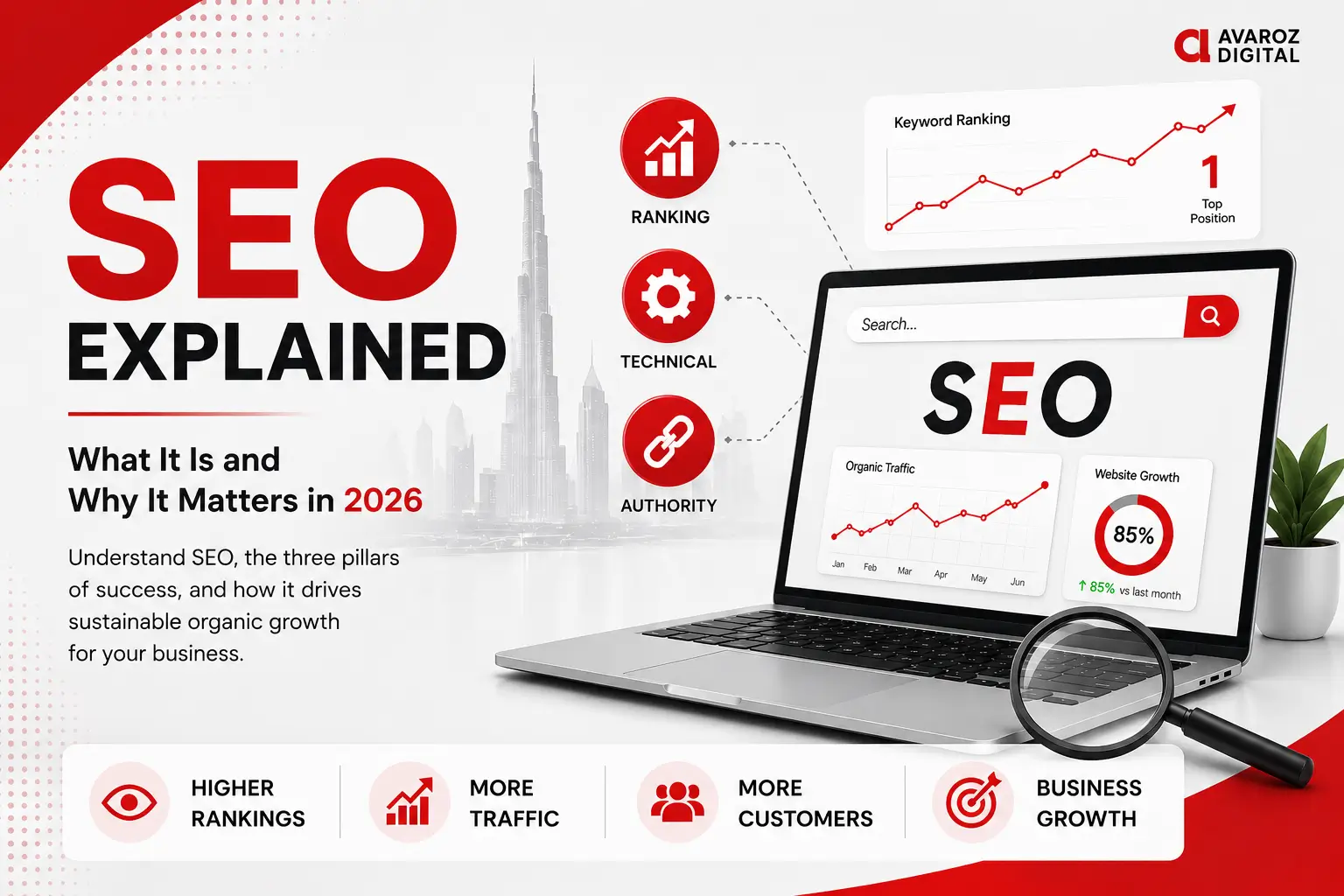
The Three Pillars of SEO
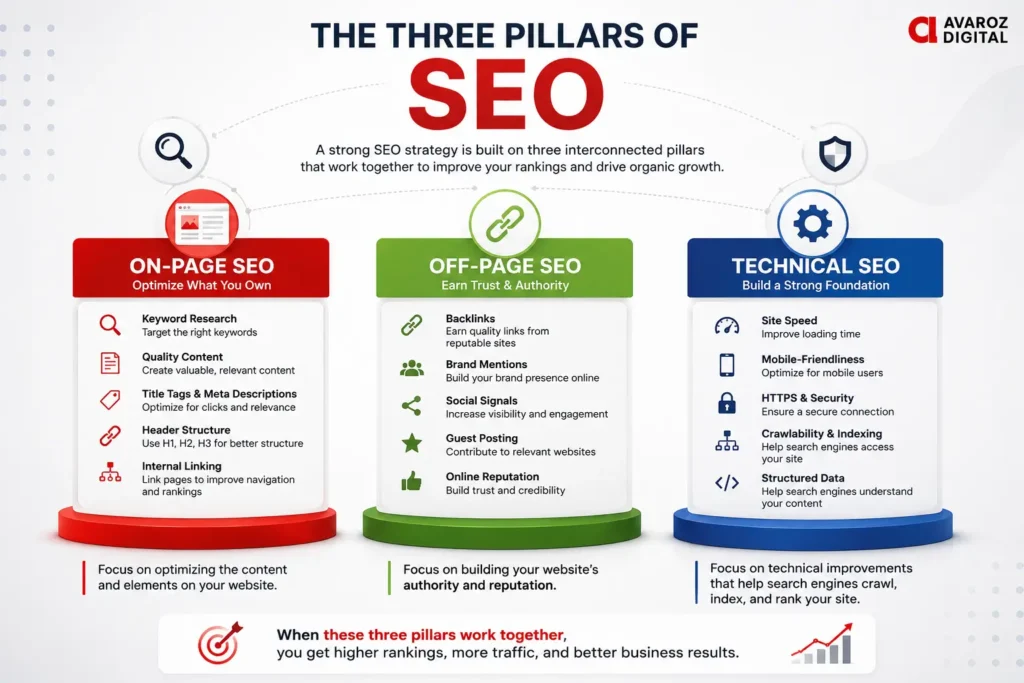
The following are the main points that you need to keep in mind about the three interconnected pillars of modern SEO. If you neglect any of them, your results will be affected.
Pillar 1: On-Page SEO
On-page optimization (also known as on-page SEO) is the things you can do on your website to make it relevant for a specific search query. This includes:
Foundation: Keyword Research and Targeting
Keywords are the words and phrases your potential customers search for in search engines. The first step to effective SEO is to determine your list of keywords that have real, relevant traffic, are relevant to what you’re selling, and are attainable for your website based on its current authority.
The aim is not to overfill the content with keywords that were previously the way to game the system, and have been killed by algorithm changes years ago in Google. Rather, you will naturally use your key and related words in your content so that it appears in a “natural” way to human readers.
Content Quality
Google’s algorithms are advanced enough to determine whether or not a piece of content actually provides value to its readers or it’s merely SEO. The content is well written, provides users with a full answer to the question, provides the user with related questions they may have, and is expert and accurate. There’s almost always a 2,000-word article that really goes deep on a topic that will outperform a 300-word page that just gets the basics done.
Title Tags and Meta Descriptions
These are what users will see in search results before clicking. The title tag is what Google can use to understand what your page is about, and to get a user’s attention to click on it. A clever meta description can make a big difference in your click-through rate, and that will factor into your ranking.
Header Structure and Internal Linking
Clear H1, H2, and H3 headers aid in the organization of your content for both users and search engines. Internal links, links that come from one page of your site to another, help spread authority throughout your site and help Google find more of your site’s content.
Image Optimisation
Google needs to know what your images are about, just like us; they must have descriptive names and ALT tags. Unoptimised images can also affect your site’s performance, as large images can make your site slower, which will have a negative impact on user experience and search engine rankings.
Pillar 2: Off-Page SEO
Off-page SEO involves establishing the authority and credibility of your website by establishing signals that lie outside of your website.
Backlinks
Votes of confidence on the Web. When other sites link to your site, they essentially vote for you. Google will give your domain more authority the more high-quality, relevant sites link to your content. One backlink from an authoritative news outlet is worth more to your ranking than a hundred spammy links from bloggers.
Strong backlinks can be acquired by publishing content that’s valuable to link to, by conducting original studies, by providing comprehensive guides, by making useful tools, or by publishing thought leadership content. It also includes relationship building, outreach and PR initiatives within your industry.
Brand Signals and Online Reputation
Google reads all of the discussion about your brand on the Internet, social media, reviews, news articles, and industry forums. If you’re using a trusted, reputable brand, it will get trust signals that will positively impact rankings. Customer reviews, social media pages and Google are all aspects of off-page SEO health.
Local Citations
For businesses that are in a particular geographic area, having uniform listings through such directories as Google Business Profile, Yelp, Bing Places, or industry-specific listings would provide strong local relevance signals. Mixing up your business name, address, and Phone number (NAP) across these channels can confuse and make it more difficult for your local business to be found.
Pillar 3: Technical SEO
Technical SEO helps search engines easily crawl, index, and interpret your site. The most successful content on the planet can suffer if it’s behind technical obstacles.
Site Speed
Google has officially announced that site speed is a ranking factor. Slow websites lose ranking and users.If it takes more than 3 seconds to load, users are going to lose interest in your site and it will lose rank. Use tools such as Google PageSpeed Insights to locate and address speed issues.
Mobile-Friedliness
Google has adopted a mobile-first indexing approach, where it first indexes the mobile version of your page if it exists. A website that is well designed for the desktop but not for the smaller screen of a smartphone is easily going to be at a disadvantage in terms of ranking.
Secure Protocol (HTTPS)
Google labels websites without SSL certificates as “Not Secure” and considers HTTPS as a ranking factor. Switching to HTTPS is a must if your site is still using HTTP.
Core Web Vitals
Google’s Core Web Vitals are a set of metrics that indicate actual user experience: loading performance, interactivity and visual stability. A website that performs well on these measures is granted a rank boost. The ones that aren’t doing well, particularly mobile, experience a measurable loss.
Structured Data
Schema markup is a code snippet you can place on your website to enable search engines to comprehend your content more precisely at a granular level. It can power rich results in search listings, star ratings, FAQs, event dates, and product prices that significantly boost your visibility and click-through rates.
Site Architecture
A logical site structure allows Google to find all your pages more easily. An XML sitemap is the roadmap, and your robots.txt file instructs crawlers on what parts of your site to visit (and even avoid). These core elements are critical for not missing out on valuable content.
Why SEO Matters for Every Business
So now you know what SEO is, let’s discuss why SEO is important for your online marketing efforts, even if you’re a small business, a large enterprise or just budget-conscious.
1. SEO Captures Demand Already in Motion
People don’t like to be interrupted by paid advertising. People are not necessarily searching for the services you have to offer when a pop-up or banner ad or even a social media promotion is encountered. SEO, on the other hand, links your business to individuals who are actively looking for it.
This is the most powerful type of intent-based marketing. If someone types the words “best accountant for a small business near me”, it means that they are ready to hire. When people Google that, they are looking for a person who is already interested in buying your product.
2. Organic Traffic Builds Compounding Returns
Once you have optimized your site, you’ll see that organic traffic continues to pay off for years to come.
As a form of marketing, one of the benefits of SEO that is rarely recognized is that it compounds over time. The positive returns of a paid ad campaign cease as soon as you stop paying for it. However, a well-optimised blog post or product page can rank and drive visitors to their website for years to come without any extra investment in advertising.
As you become more authoritative in the eyes of Google, you’ll be able to get more backlinks, and your domain reputation will keep rising as well, which means that each time you create more content, it will appear in the search engine results pages sooner and higher. This forms a virtuous cycle; if you invest in SEO in the beginning, it will be beneficial to all the content you build in the future.
3. SEO Builds Trust and Credibility
Organic search results are more trusted than paid ads by users. Having your site at the top of Google’s results is a sign that it is relevant and good, according to Google, a trusted third party. This is called a ‘soft’ endorsement, and it makes you more believable to a visitor before they click on your link.
On the other hand, companies that are solely counting on paid advertisements are in trouble to have trust among users who are accustomed to ignoring the “Sponsored” tag.
4. SEO Delivers a Superior Long-Term ROI
SEO takes time and budget to get right, from the initial work to improve the website, creating quality content, to building links. The ROI on that investment, though, is usually much higher over the long term than the ROI of paid channels.
According to all industry research, the conversion rate for organic search is much higher than paid search. If you’re in a niche that is competitive, getting on the first page of Google can bring hundreds or thousands of visitors to your site, visitors who do not pay per click.
5. SEO Works for Every Business Size
One of the biggest misunderstandings about SEO is that it’s the exclusive domain of large corporations with large budgets for marketing. The actual situation is far from this.
After all, SEO is truly levelers. A small business with a great website optimized for local search will beat a national chain on local search. Very good content can dominate specific product-related search terms in a niche e-commerce store. It’s not about having a Fortune 500 budget, it’s about smart strategy, consistent execution and patience.
6. SEO Provides Measurable, Actionable Data
Measurability is one of the best things about digital marketing over traditional marketing, and SEO is no exception. Google Search Console, Google Analytics, and third-party SEO tools provide detailed data on how your website is being found, the keywords people are using, where they are losing them, and how your rankings are performing over time.
This information isn’t only good for your SEO, it’s the basis for your entire business strategy. When you know what your audience is looking up, you have direct insight into their needs, concerns and purchase intent.
7. SEO Supports Every Stage of the Customer Journey
Customers are not always going to purchase when they first become aware of a product. They look for new ways to compare and abandon, return, and reconsider. With SEO, you can develop local content that can help with each step of this journey.
If people are in the awareness stage and have a problem, but don’t know the solution, blog posts and educational guides can draw visitors to them. For those in the consideration stage, pages that make comparisons and provide product-oriented information are helpful.
Optimized pages for products and services turn those who are ready to buy. A unified approach to SEO content means your brand is there at every touch point.
Common SEO Mistakes That Hold Businesses Back
While it is essential to know what to do, it is just as essential to know what not to do.
Ignoring Keyword Research: Users who write intuitively, rather than based on data, will be writing for terms that no one is searching for, or targeting a highly competitive term before they can have the authority to rank for it.
Prioritising Quantity Over Quality: Quality over quantity: 20 thin, rushed blog posts will not be as effective as 5 well-researched, useful blog posts. Google’s algorithms are now pretty effective at telling the difference between useful information and filler content.
Neglecting Technical SEO: However, the beauty of content can’t overcome a website that loads slowly, doesn’t work well on mobile devices, or has crawling problems that prevent search engines from accessing important pages.
Expecting Overnight Results: SEO is a long game. Businesses should not expect to see huge boosts in their rankings within weeks; it is impossible. The most successful SEO campaigns can start to deliver results within 3-6 months; after 12-24 months, even better results can be seen.
Buying Cheap Links: Poor link schemes and private blog networks can lead to Google penalties and can take months to recover from. Earning links through natural means or by outreach is always the better and safer way.
SEO in the Age of AI and Generative Search
Google’s search environment is changing quickly. Google’s new AI Overviews (previously known as Search Generative Experience) have started to alter the appearance of search results and how people engage with them. Certain queries now prompt to show AI-generated summaries at the top of the page, which glean information from various sources.
This doesn’t mean SEO isn’t important; it just puts the stress on content quality. Google’s AI uses authoritative, trustworthy sources. AI-driven summaries are more likely to mention those businesses that have invested in robust SEO, authoritative content, and credible backlinks and have established clear expertise.
With the emergence of voice search and conversational AI assistants, the need for natural language content is becoming increasingly significant. What people ask and how they ask it is becoming more and more a core aspect of contemporary SEO optimization.
Conclusion
With the Internet being the first place where most people are likely to encounter your business, your website has the potential of being your first impression. The impression never occurs if potential customers cannot find you in search results.
SEO does not have to be a tech trick that only tech companies or large marketing teams can utilize. It is a basic investment in your business, and one that, if implemented properly, can generate compounding returns, establish a strong reputation over time, and ultimately integrate your business with those who may become its loyal customers.
SEO principles are applicable to any type of business, whether you are a local service provider, an e-commerce brand, a B2B business, or a content-driven platform. The companies that stick to it regularly are the ones that are creating long-term visibility, and others are still paying for each click.
Frequently Asked Questions
What is SEO?
SEO (Search Engine Optimization) improves your website’s visibility on Google and other search engines to attract free organic traffic.
How long does SEO take?
Most websites see results within 3–6 months, while competitive industries may take 12+ months for strong growth.
SEO vs PPC?
SEO earns unpaid traffic through optimisation and content. PPC delivers instant paid visibility, but traffic stops when ads stop.
Is SEO still relevant in 2026?
Yes. Despite AI search features and voice search, high-quality content, technical SEO, and backlinks still drive rankings and visibility.
What are the top SEO ranking factors?
Key factors include content quality, backlinks, page speed, mobile-friendliness, keyword optimisation, and website authority.
What is on-page vs off-page SEO?
On-page SEO covers content, keywords, and site optimisation. Off-page SEO focuses on backlinks, reviews, and brand authority.
