
The UAE has become one of the most enticing places for ecommerce business owners to set up shop. The population is connected digitally, their income is high, online payment systems are secure, and government policies and programs are favorable for online business start-ups.
There are endless opportunities to create a successful ecommerce brand, whether you’re looking to sell fashion items, electronics, beauty products, homes and decor, or handmade items.
As aspiring business owners, you have questions like how to start an ecommerce business, how to start an ecommerce business in Dubai, or how to open an ecommerce store without knowing where to get started.
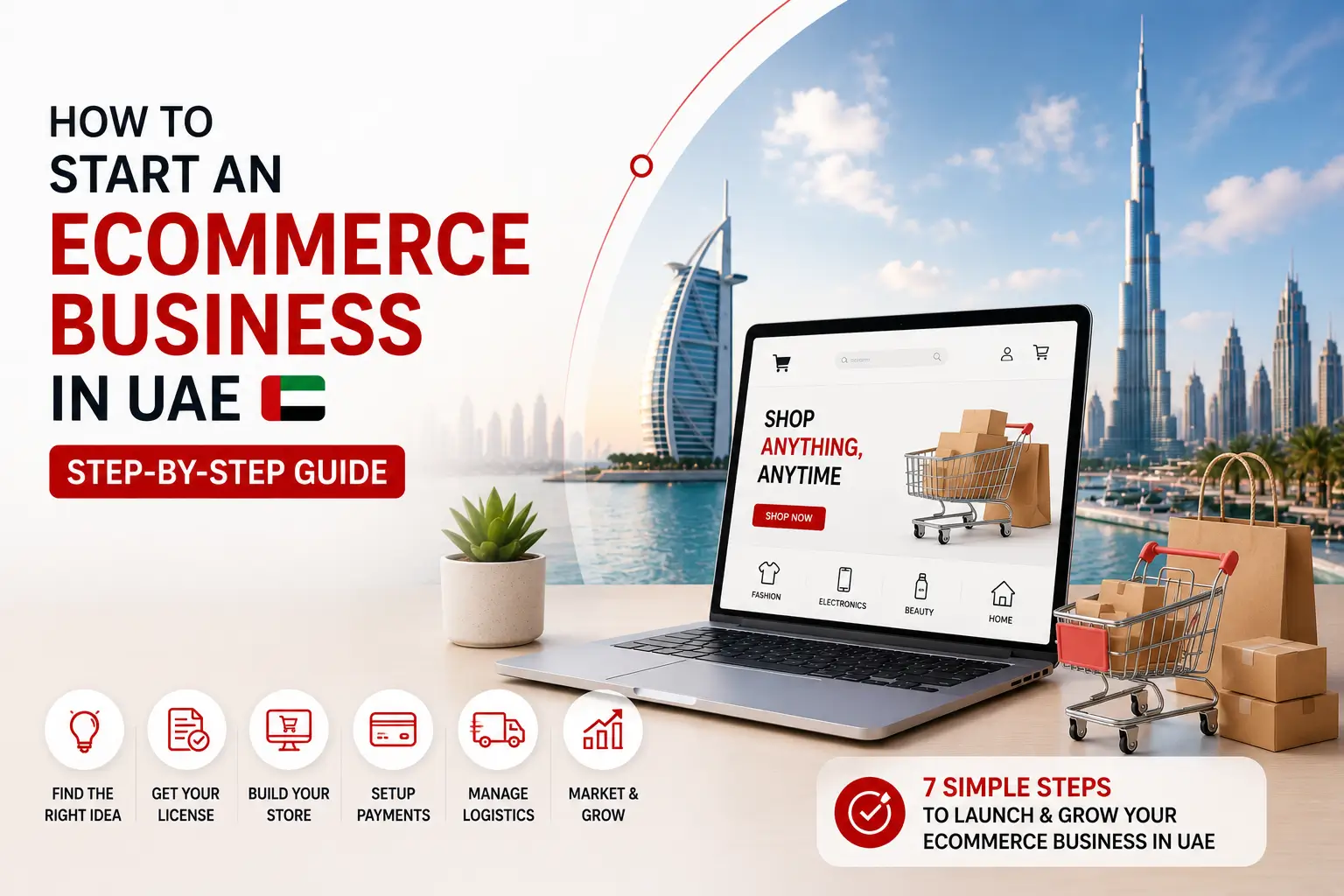
This guide takes you through each step, from picking the right business model and securing an ecommerce trade licence, to selecting an ecommerce platform, configuring your payment channels, organising your logistics and marketing your store from the get-go.
Why Establish An Ecommerce Business in the UAE?
In recent years, the UAE’s ecommerce sector has seen significant growth, fueled by changing consumer behaviors and the accelerated digital transformation trend. This rapid growth has also increased the demand for a reliable ecommerce agency in Dubai to help businesses launch, manage, and scale their online stores.
With the advent of e-commerce, people have begun to consider it as the preferred choice because of its ease of shopping, quick delivery, and secure payment systems.
Concurrently, the government’s thrust on entrepreneurship has contributed to an easier process of entrepreneurship registration and operation of an online business.
The country’s strategic location is another great plus. The UAE is a great location for businesses to tap into the trading opportunities in the GCC region, as well as in Asia, Europe, and Africa. These, along with the world-class logistics infrastructure and tax-friendly business environment, make UAE an ideal business destination for the entrepreneurs to create a scalable ecommerce venture.
So, if you are wondering how to start my ecommerce business and grow online your ecommerce business, then you have the option of choosing the UAE, you’ll find it to have a well-developed digital environment that allows for rapid growth of online businesses if you plan and execute the right way.
Step 1: Find the Appropriate Business Idea
The first and most important step in any successful ecommerce business is to find the right products and understand your target audience. Do not sell products just because they are ‘hot’ or in demand, but because they solve a customer’s problem or meet a constant need in the UAE market.
The most popular ecommerce categories are fashion, cosmetics, electronics, home accessories, baby, fitness, pets, Islamic gifts, and personalized items. Research your competition, compare pricing and find out where there is a need for your business to provide something different.
You also need to make a decision on how you will handle your inventory. There are basically three models of ecommerce that entrepreneurs can choose to follow.
Inventory – Based
Inventories are stocked in advance and sold when orders are received. This demands a higher initial capital, but gives more control over product quality, packaging and delivery times.
Dropshipping
Dropshipping enables the suppliers to ship products directly to the customers once the order is placed. As you don’t have to keep stock, startup costs are relatively low. But it’s a more competitive business with less profit and customer satisfaction is highly dependent on your suppliers.
Print-On-Demand
Another emerging alternative is print-on-demand, which is especially appealing for business owners that are producing customized products like T-shirts, mugs, tote bags, and phone cases. Only products are being created after a customer orders them, so there is no need to make the initial investment in inventory.
Your decision on the business model you choose will affect your startup costs, how your business functions and how it will grow in the future.
Step 2: Determine Where to Register your Business
Choosing the jurisdiction of your company is one of the critical aspects of starting an ecommerce business in Dubai or the UAE. Your selection will impact on license fees, business flexibility, expansion and operating costs.
Typically, entrepreneurs have to settle for Dubai, Sharjah or Abu Dhabi, each of which has its own advantages based on the business objectives and budget.
Dubai
The city’s reputation for being a global hub and its well-established business environment continue to make Dubai the preferred choice for ecommerce startups. The city has unparalleled logistics, international connectivity and a huge customer base.
Many business owners decide to move to Dubai as a result of the added value for the credibility of their brand and the ease of further expansion.
Trade licences for ecommerce businesses begin at AED 5,750+ and will depend on other factors, including the ecommerce licensing authority, visa requirements, and other business activities you plan to pursue.
For those looking to create a high-end ecommerce brand or to reach global markets, Dubai can be a more viable option.
Sharjah
Entrepreneurs who are running a business on a low budget will find Sharjah to be an option that does not cost them much, and does not affect the opportunities of business.
The fact that the licence fees are reduced and the cost of set up packages is also economical makes this very alluring to first time business owners and small online retailers.
Many startups opt for Sharjah as it gives them the advantage of starting with less investment and still catering to the customers of the UAE.
Abu Dhabi
With its thriving business environment and sustained support for innovation and startups, Abu Dhabi is becoming a great place for ecommerce ventures to flourish.
Abu Dhabi is a popular choice for businesses looking towards long-term growth or investment prospects due to its culture of fostering technology-driven businesses.
The startup costs generally fall with Sharjah and Dubai, however, the emirate provides a great opportunity to those planning to go for business expansion.
Dubai vs Sharjah vs Abu Dhabi: Which Licence Is Right for You?
| Feature | Dubai | Sharjah | Abu Dhabi |
| Starting Licence Cost | AED 5,750+ | Lower than Dubai | Moderate |
| Startup Expenses | Higher | Affordable | Medium |
| International Brand Value | Excellent | Good | Excellent |
| Business Growth Opportunities | Very High | High | High |
| Investor Access | Excellent | Moderate | Excellent |
| Best For | International brands and scaling businesses | Budget-conscious startups | Technology and growth-focused companies |
While many entrepreneurs focus solely on licence fees, it’s important to think beyond the initial investment. Choosing the right jurisdiction should support your long-term business strategy rather than simply reducing startup costs.
Step 3: Apply for an Ecommerce Trade Licence
One of the most crucial legal requirements for running an ecommerce business in the UAE is getting an ecommerce trade licence.
You can’t sell products, accept online payments, open a business bank account or do business with most logistics providers without a valid licence.
The application procedure is quite simple, particularly when applying through UAE’s eBusiness registration systems.
Requirements differ from agency to agency, but the typical steps an entrepreneur takes to start a business include choosing a business activity and reserving a company name.
The remaining documents are then submitted prior to the payment of licence fees and the official licence is issued when these are approved.
Most of the time, you will be required to submit:
- A copy of the passport showing the validity.
- Make a copy of your Emirates ID and visa (if applicable).
- Passport-sized photograph
- The proposed business activity information.
- Approved trade name
Numerous free zones are now online, which means that entrepreneurs are able to register a company online for most of the process. This has markedly shortened setup periods, enabling numerous ecommerce companies to start in a few days.
As your licence is approved and you get on with creating the online store, this is where your business starts to take shape and where you can start to welcome those first customers, opening up the door for your business to flourish.
Step 4: How to Open an Ecommerce Store.
After receiving the approval of your trade licence, it’s time to construct your online store. This is when many entrepreneurs begin to ask how they can create an ecommerce store that looks professional, and more importantly, leads visitors to their website to become paying customers.
Your site’s appearance is your company’s face, and so, it ought to present a smooth purchasing journey, from the homepage through to the point of sale. Even the best products can be lost if your site doesn’t load quickly or is poorly designed.
The first step is to select an interesting domain name that will identify your brand. It should be short, easy to spell and be relevant to your niche. A .ae domain may be considered appropriate for businesses that are focusing their business on customers in the United Arab Emirates, while a .com domain might be more suitable for businesses that will be expanding internationally.
Your ecommerce store should have all of the pages that customers are looking for such as:
- Homepage
- Product categories
- Individual product pages
- About Us
- Contact page
- Privacy Policy
- Shipping Policy
- Returns and Refunds Policy
- Frequently Asked Questions (FAQs)
Outside of these pages concentrate on the enjoyable shopping experience. Product photos require you to be professional and show the product from several perspectives. Product descriptions should address common customer questions, rather than just specifications, by identifying product features, benefits, dimensions, materials, delivery and other questions.
In the UAE, most shoppers will be browsing and buying products through their smartphones and your website needs to be 100% responsive. Having a mobile responsive design, loading quickly, and having a secure checkout process are as much a part of it as they are a necessity when it comes to building customer confidence.
Selecting a Suitable Ecommerce Platform
One of the most important choices you’ll have to make is the platform that will power your online store. The decision comes down to your budget, technical skills, business objectives and plans for expansion.
Shopify, WooCommerce, and Salla are the three main platforms in the UAE ecommerce market. Each has its own unique benefits to certain categories of businesses.
Shopify
Shopify is considered to be the easiest platform for beginners. It offers a complete package solution, with hosting, security, payment integration, and ready-made templates.
The other benefit is its huge app marketplace that enables you to integrate different features like email marketing, inventory management, loyalty programmes and customer reviews with ease. Shopify has a monthly fee, but for many entrepreneurs, it’s worth the hassle.
WooCommerce
It is created on WordPress and supplies limitless versatility to companies that want total control of its websites. It is an open source platform, unlike Shopify, where you can customize almost anything you can do on your online store.
Businesses that put a considerable effort into their content marketing and SEO campaigns favor WooCommerce because of the seamless way it plays with WordPress blogs.
You will, however, need to secure a separate hosting, security and website maintenance, which is more suited to the needs of entrepreneurs who have technical expertise or are able to hire a web developer to handle these needs.
Salla
Salla is gaining more and more popularity in the whole GCC region, especially among the businesses that cater to the Arabic speaking people. It’s tailored for the regional market and comes with functionality to support local payment methods, shipping services, and bilingual ecommerce stores.
The user-friendliness of its interface enables entrepreneurs to start their businesses quickly, while providing robust language support for the Arabic language and also having business integrations that are appropriate for UAE and Saudi businesses.
Shopify vs WooCommerce vs Salla
| Feature | Shopify | WooCommerce | Salla |
| Ease of Use | Excellent | Moderate | Excellent |
| Hosting Included | Yes | No | Yes |
| Monthly Cost | Medium | Low | Affordable |
| Customization | Good | Excellent | Moderate |
| SEO Flexibility | Good | Excellent | Good |
| Arabic Support | Limited | Good | Excellent |
| Best For | Beginners and startups | Growing brands requiring flexibility | GCC-focused businesses |
Step 5: Secure Payment Gateways
No ecommerce store is without a secure and reliable payment system. Customers will want to complete their purchases in a timely and secure fashion, and providing several payment options can greatly boost your conversion rate.
UAE residents regularly pay for online purchases with a credit card, debit card, Apple Pay, Google Pay, and Buy Now, Pay Later options. Despite the increasing growth of digital payments, Cash on Delivery (COD) is still loved for certain product categories, especially when it comes to the first customers, who like paying on delivery.
Don’t just consider transaction fees when choosing a payment gateway. A secure provider will provide robust security, fraud protection, seamless integration with your ecommerce platform, and support for AED transactions. The checkout process should also be simple and straightforward, with no unnecessary steps or redirects for customers to follow.
Having an online payment option as well as Cash on Delivery is a great way for many successful ecommerce businesses to start. This strategy is attractive to a broader customer base and works to create trust among those consumers that might be reluctant to buy online first.
Step 6: Plan Shipping and Logistics.
The UAE has one of the best logistics systems in the region, allowing businesses to offer delivery services within a day of ordering in many cities. Selecting the right delivery partner, though, depends on your business size, product type and target audience.
As you compare logistics providers, take into account delivery time, shipping charges, geographical reach, tracking the packages, returns management, and customer support.
Keeping customers informed about the tracking updates and delivering the goods with transparency will aid in managing the whole shopping experience and decrease the amount of customer queries.
You should also establish return and shipping policies before opening your ecommerce store. The delivery fee, estimated delivery timings, exchange policy and the eligibility for returns should be easy to understand for the customers.
Clear policies minimize confusion and boost customer trust, particularly for your first-time buyers.
If you are looking to expand outside the UAE, be sure your logistics partner has international and GCC shipping as part of their portfolio. The scalability of logistics from the start will make it easier to scale in the future.
Step 7: Start Marketing Before You Launch
One of the biggest misconceptions among the new entrepreneurs is that their customers are going to stumble upon their website after they have made it available to the web. The truth is no matter how well designed your ecommerce store is, it needs constant marketing to attract traffic and sales.
Smart companies get their brand out there before the product is released. Using social media, building email lists and dropping hints about behind-the-scenes activities will help create excitement before your product is even available.
Search Engine Optimization (SEO)
The first priority of your marketing efforts should be search engine optimization (SEO). Optimizing your product pages, category pages and blog for the right keywords like “how to start an ecommerce business” or “how to start an ecommerce business in Dubai”, etc. makes your website more visible on Google with time.
Partnering with a professional SEO agency Dubai can further strengthen your strategy by improving your website’s rankings, driving qualified organic traffic, and helping your ecommerce business achieve sustainable long-term growth.
Social Media
Social media also has a critical function in ecommerce triumph in the UAE. Social media like Instagram and TikTok are particularly good at visually promoting products in short videos, show-and-tell videos, customer reviews, and behind-the-scenes videos. Companies that regularly create content that resonates with their target audience tend to develop a loyal following along with sales.
Paid Advertising
For business growth, paid advertising can help to boost the growth, especially in the initial stages of your business. Google Ads can be used to target people who are actively looking for products, and Meta Ads and TikTok Ads can be used to target specific demographics and interests and people who have been online for a certain period of time. Analysis of campaign performance and a small budget can help to get the maximum return on investment.
Email Marketing
But even in an online landscape dominated by social media, email marketing is still one of the most effective methods available. Inviting visitors to sign up for special discounts or offers can help you create a valuable customer list. From welcome emails to abandoned cart reminders, product launches and seasonal promotions, all of these double as efforts to build customer relationships and increase repeat sales.
Influencer collaborations
Last but not least, don’t underestimate the power of collaboration with influencers. UAE brands have found that working with micro-influencers who have audiences that are similar to their target customer can yield great results. For new brands, typically, authentic product reviews and demos can be more trustworthy than standard ads.
Common Pitfalls to Avoid in an Ecommerce Business.
Despite having a great business concept, many ecommerce startups fail due to avoidable errors. Knowing about these challenges prior to launch can save time and money.
Not Prioritizing Search Engine Optimization
Some business owners think that advertising is enough to make consistent sales. But all advertising eventually gets costly. Investing in SEO early in your site’s development can help you gain a better rank for relevant keywords, drive organic traffic to your site, and decrease the cost of customer acquisition.
Using Poor Product Images
The images are important in helping to create trust with the online shopper, as they can’t see the product “in real life” before they buy it. Clear, detailed images from a variety of angles convey to the customer exactly what they’re purchasing, and can even boost conversion rates.
Complicating the Checkout Process
The more steps a customer has to take to checkout the more likely they are to drop out. Multiple payment options, clear delivery information, and guest checkout options provide a streamlined checkout process that leads to more successful transactions.
Neglecting Customer Support
Customer service can be the set of distinctions that make successful ecommerce businesses stand out from the rest. Prompt answers to questions, efficient handling of complaints and clear communication on deliveries and returns can convert new users into regular ones.
Conclusion
Learning how to start ecommerce business in the UAE is about more than simply creating a website. The key to success is establishing a solid base of legal compliance, customer-centered design, dependable operations, and marketing consistency.
These steps to create an ecommerce business will help you take the leap from idea to launch with confidence. The first step is to pick a profitable niche and select the right jurisdiction for your company, be it Dubai, Sharjah or Abu Dhabi. Get an ecommerce trade licence; develop your online store with an ecommerce platform that suits your businesses requirements; connect secure payment methods, and collaborate with reliable logistics carriers.
Your marketing strategy is also crucial. Those companies that start investing in SEO, social media, paid advertising, and email marketing from the ground up are better prepared to market their products and services and grow for a long time.
If you’re looking for expert support throughout your ecommerce journey, Avaroz Digital can help with ecommerce development, SEO, and digital marketing solutions to build and scale your online business in the UAE.
Frequently Asked Questions (FAQs)
What are the initial costs of an ecommerce business in the UAE?
It is dependent on the jurisdiction, business model and operational needs. The typical cost of an ecommerce trade licence is around AED 5,750, and extra fees cover website setup, branding, marketing, stock and payment gateway integration.
Can foreigners launch an ecommerce business in Dubai?
Yes. Foreign entrepreneurs are able to set up ecommerce businesses with a Dubai company on the mainland or in a free zone. Foreign investment is encouraged in the UAE, with many options available for setting up businesses with 100% foreign ownership.
What is the best eCommerce platform for a new business?
Shopify is typically a simple platform for novices since it offers hosting, security, payment solutions, and easy store management tools. For those looking for more customization, WooCommerce is a great option, while for brands in the GCC region with Arabic language support, Salla is a strong contender.
Can I sell online without a trade licence in the UAE?
Yes. To conduct business legally, accept online payments, open a business bank account and work with shipping and logistics partners in the UAE, you need to have a valid ecommerce trade licence.
What is the minimum duration of an eCommerce company?
Most business people can start their online business in two or four weeks. The period of time will vary based on the speed at which the trade licence is issued, the complexity of the website, and the number of hours needed to upload products, set up payment gateways and test the website online before it’s launched.
