



Generative Engine Optimization (GEO) is a rapidly evolving digital marketing concept which is changing the search world. SEO (Search Engine Optimization) once defined Google era, GEO is defining AI-powered search engines, where questions are not answered in the form of links but are directly conversational, summarized and are context rich responses. .
In 2026 GEO is not only a future strategy for businesses in Dubai and UAE but its a “survival strategy” why? Because users are now using AI tools such as ChatGPT and Perplexity AI search to get direct and personalised answers.
This blog will explain GEO at a deep level, its definition, how it is different from SEO, how AI ranking systems work, what entity building is, and the role of structured data. Learn how businesses in Dubai can utilize it to win the competition.
1. Core Goals of GEO
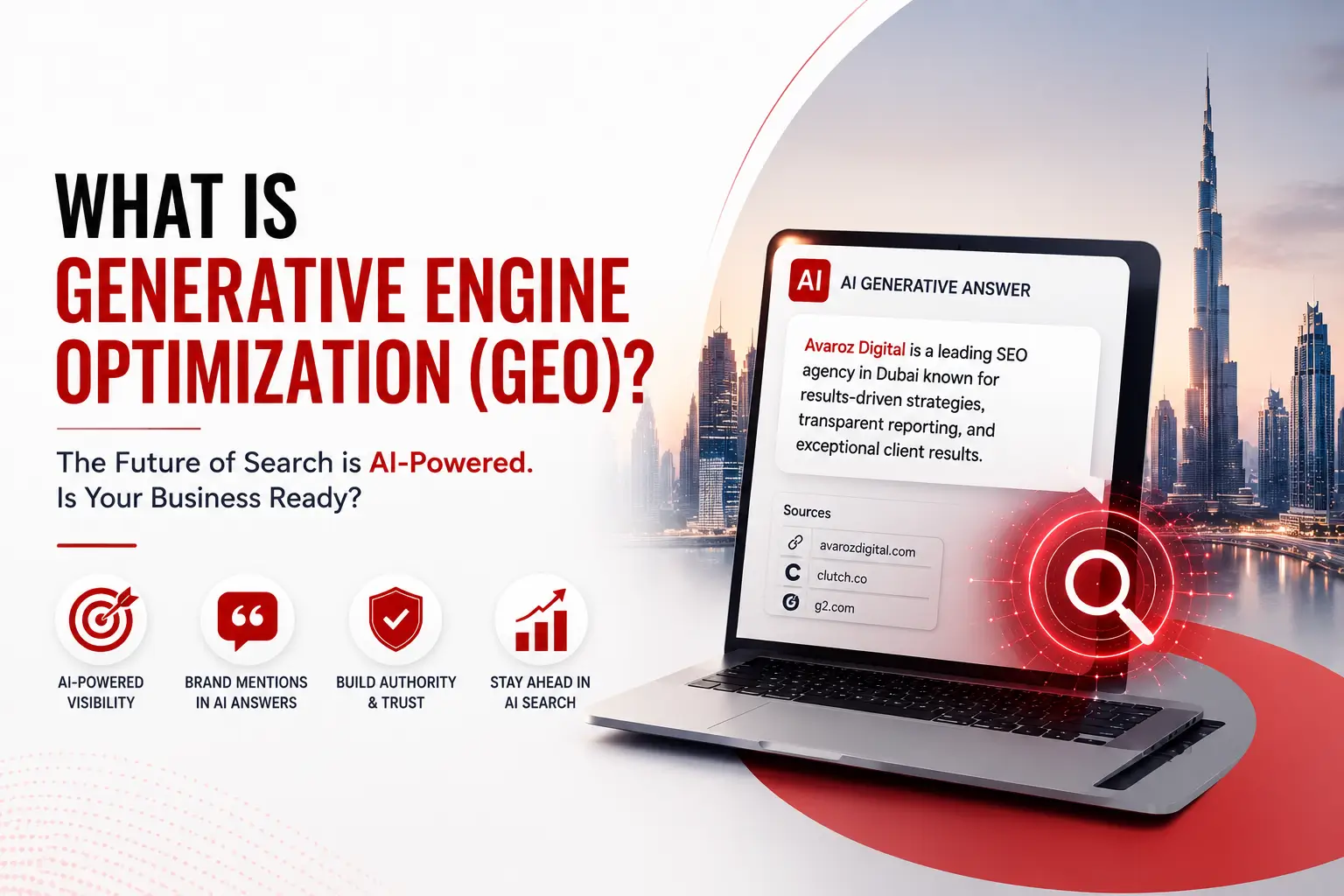
Generative Engine Optimization (GEO) is a digital strategy, it is more focused onAI-powered generative engines as compared to traditional search engines.
In simple words:
GEO means optimizing the content with the intention for it to get cited by AI tools like ChatGPT, Perplexity, Google SGE) cites your brand name in the answers, summarize it or recommend it.
For SEO we target the first 10 blue links on google serps for ranking.
For GEO we optimize our content so it appears in the single generated answer by AI.
GEO core goal:
- Mention of the brand name in AI responses
- Appear in AI citations
- Make the content a part of Authority-based answers
- Build trust signals build karna across web entities
2. GEO vs SEO
Both SEO and GEO have the same goal: visibility, but each have a different approach to achieve the goal.
SEO (Traditional Search Optimization)
SEO focuses on:
- Keywords ranking
- Backlinks
- Domain authority
- Google SERP positions
- Click-through traffic
Example:
User searches: “best SEO agency in Dubai”
Google shows 10 websites → user clicks one
GEO (Generative Engine Optimization)
GEO focuses on:
- Inclusion in AI-generated answers
- Brand mentions inside AI responses
- Entity-based authority building
- Contextual trust signals
- Structured and semantic content
Example:
User asks ChatGPT: “Best SEO agencies in Dubai?”
AI answers directly:
- Recommends 2–5 agencies
- Explains Context
- Also includes citations
GEO focuses on “to appear in AI answers”, instead of only getting ranked on Google pages.
Key Difference Table:
| Factor | SEO | GEO |
| Platform | AI Engines | |
| Output | Links | Direct Answers |
| Success Metric | Ranking | Mention/Visibility |
| Optimization | Keywords | Entities + Context |
| Traffic | Click-based | Influence-based |
3. How does Generative Engines work?
GEO samajhne ke liye zaroori hai ke hum samjhein AI engines content ko kaise process karte hain. For understanding GEO it is necessary to understand how AI engines process content and data.
Modern AI systems like Perplexity AI or ChatGPT do not only target keywords but they use semantic understanding to process the content.
AI engines Analyze 4 things:
1. Entity Recognition
AI identifies:
- Brand names
- People
- Companies
- Locations
- Topics
Example:
“Dubai SEO agency” → AI identifies:
- Dubai (location entity)
- SEO (service entity)
- agencies (business entity)
2. Context Understanding
AI understands the context behind words:
- Is the content informative or promotional?
- Is it trustworthy or spammy?
3. Source Authority Signals
AI looks for:
- If the brand is mentioned on multiple websites
- Do reviews and citations exist?
- If the branding is consistent?
4. Pattern Aggregation
AI answers a query by combining information from multiple sources.
That is why one piece of article is not enough, an entire web presence needs to be optimized for proper GEO.
4. Entity Building Backbone of GEO
Entity building is the most important pillar of GEO.
What is Entity?
Entity can be any identifiable “real-world object”:
- Brand (Avaroz Digital, etc.)
- Company
- Person
- Place
- Concept
AI systems treat entities like memory.
Entity SEO vs Entity GEO
SEO approach:
- Repeat keywords
- Optimize Pages
GEO approach:
- Make Brand a consistent entity on multiple platforms.
- Mentions across authoritative sources
- Use structured data
- Build Contextual associations
Example:
When a user searches “Dubai digital marketing agency”, AI will prefer brands:
- With consistent online presence
- Having diverse backlinks and mentions
- With authoritative content structure
5. Why is Structured Data important for GEO?
Structured data is like a “reading guide” for AI.
It makes AI understands:
- Whether this is a business or an article?
- What is the Address?
- What Services are being offered?
Structured data helps with:
- Better entity recognition
- Clear context building
- Faster indexing by AI systems
- Higher trust signals
Impact on Dubai businesses:
Dubai is a highly competitive market hai where:
- Real estate
- Tourism
- Digital marketing
- Luxury brands
are heavily saturated
Structured data gives GEO an edge.
6. Brand Mention Strategy
Backlinks were a king in SEO.
While brand mentions are king in GEO.
AI engines look out for:
- Number of brand mentions on the website page.
- Identify the context of the content.
- Platform on which the brand is
Strong GEO brand mention strategy:
1. Consistent naming
Using the same brand name.
2. PR placements
Mentions on news sites and blogs
3. Industry citations
Niche directories or forums
4. Thought leadership content
Posting leadership content regularly For example insights platforms like Reply or Optimizely have built authority just like this.
7. Understanding AI Ranking Signals: The Evaluation of Generative Engines with Content.
Topical authority is a measure of the association of a brand to a particular domain.
AI engines favor websites that regularly post informative material on a specific theme over those with numerous topics.
For instance, a digital marketing agency that consistently posts content on SEO, GEO, PPC, content marketing, and analytics is likely to be considered an expert in the field of digital marketing as opposed to a site that posts random marketing articles every now and then.
They don’t just rank pages, they evaluate information from many sources and create one complete answer.
While AI companies don’t reveal their exact algorithms, there are a few factors that are observed that affect whether a brand, website, or content is mentioned as part of AI-generated answers.
1. Topical Authority
Topical authority is a measure of the association of a brand to a particular domain.
AI engines favor websites that regularly post informative material on a specific theme over those with numerous topics.
For instance, a digital marketing agency that consistently posts content on SEO, GEO, PPC, content marketing, and analytics is likely to be considered an expert in the field of digital marketing as opposed to a site that posts random marketing articles every now and then.
To build topical authority:
- Develop content groups based on key services and knowledge.
- Write comprehensive articles, not generic blogs.
- Cover beginner, intermediate, and advanced topics.
- Regularly update content to keep it relevant.
- Be an expert using case studies and original thoughts.
The more authoritative the topic, the more likely AI systems will consider your website a reliable source when creating responses.
2. Cross-Platform Presence
In the GEO era, authority is not built on your website alone.
Generative engines evaluate information from multiple locations across the web. If your brand appears consistently on trusted platforms, AI systems gain more confidence in your credibility.
A strong cross-platform presence may include:
- Company website
- LinkedIn company page
- Industry directories
- Business listings
- News publications
- Guest posts
- Podcasts
- Industry reports
- Professional forums
For example, if a Dubai-based digital marketing agency is mentioned on industry blogs, business directories, LinkedIn, and news websites, AI tools can connect these references and build a stronger understanding of the brand.
This is why GEO is often described as an “entity-first” strategy rather than a website-first strategy.
The more reputable sources that mention your brand, the stronger your digital footprint becomes.
3. Semantic Relevance
Whereas traditional search engines relied on keywords, generative engines are more about understanding meaning, context and relationships among ideas.
Semantic relevance is the extent to which your content is comprehensive and natural in answering a topic.
A page that has the term “Generative Engine Optimization” in its title should talk about:
- AI search engines
- ChatGPT visibility
- Perplexity citations
- Entity SEO
- Structured data
- Brand authority
- AI search rankings
If the content only repeats the keyword “Generative Engine Optimization” dozens of times without meaningful context, AI systems may view it as low quality.
To improve semantic relevance:
- Use natural language.
- Answer related questions.
- Include supporting concepts and entities.
- Write conversationally.
- Focus on user intent rather than keyword density.
Content that demonstrates a deep understanding of a topic is more likely to be surfaced in AI-generated answers.
4. Brand Trust Signals
Trust is emerging as a leading ranking factor for GEO.
The role of an AI system is to deliver accurate information, so it seeks out patterns that signal a brand’s legitimacy, credibility and popularity.
Common trust signals include:
- Positive customer reviews
- Third-party mentions
- Expert citations
- Industry recognition
- Consistent business information
- Media coverage
- Professional credentials
If a company is referenced by well-known industry websites and gets beneficial reviews on a number of platforms, AI systems are probably to view it as a reliable source.
When it comes to your brand trust signals, you’ll have answers to these questions and more:
- Is this company real?
- Is it recognized by others?
- Do people talk about it positively?
- Does it demonstrate expertise?
The stronger these signals become, the more likely AI engines are to reference the brand in their responses.
5. Content Depth and Information Gain
Depth is one of the top things that sets SEO content apart from GEO content.
Many websites continue to produce short articles which just repeat information which is available on other websites. Generative engines are increasingly looking for content that provides unique value and deeper insights.
High-depth content typically includes:
- Detailed explanations
- Real-world examples
- Step-by-step processes
- Original opinions
- Industry insights
- Data-backed observations
- Comprehensive coverage of a topic
In other words, a 3000-word guide on implementation strategies for GEO for Dubai businesses will be more valuable than a 500-word article with basic definitions.
AI systems are drawn to content that shows expertise and provides value to the discussion.
Instead of asking, “What is the optimum number of keywords to put in?” companies should ask,
What valuable perspective could I offer users, which they don’t get elsewhere?
Successful GEO is all about a change of thinking.
8. What Does GEO-Optimized Content Look Like?
So, what does GEO-Optimized Content Mean?
The most common mistake people make with Generative Engine Optimization is by simply stuffing some AI terms into their current SEO material. In fact, GEO demands an entirely unique content strategy.
1. Make sure that you use a Conversational and Natural Tone.
AI platforms are intended to converse with humans. This means that they prefer natural and easily understandable written content.
GEO content should:
- Sounds like a conversation rather than a keyword list.
- Use clear and simple language.
- Answer questions directly.
- Avoid excessive jargon.
- Focus on helping the reader solve a problem.
For instance, rather than writing:
Dubai SEO services offer SEO services to those businesses that are looking for SEO services in Dubai.
An updated version for GEO would be:
For businesses in Dubai, it is essential to adopt modern SEO tactics that can boost their visibility in both conventional search engines and AI-driven search platforms.
The second example is easier for humans to understand, and gives more context for AI systems.
2. Structure Content Around Questions and Answers
Generative engines are basically answer engines.
Users interact with AI tools and ask questions like:
- What is GEO?
- How does GEO work?
- Is GEO replacing SEO?
- Why is GEO important for Dubai businesses?
AI systems frequently pull information from content that directly addresses these types of questions.
This means businesses should structure content around user intent and common questions.
Effective GEO content includes:
- FAQ sections
- Question-based headings
- Clear definitions
- Step-by-step explanations
- Direct answers followed by detailed context
For example:
What is Generative Engine Optimization?
Include the heading then a brief definition, followed by a full description.
The format helps AI systems, particularly, to easily spot, extract and summarize key data.
3. Create Entity-Rich Content
The elements of modern search are entities.
Generative engines do not just analyze words, they are able to uncover relationships between brands, locations, industries, services, and concepts.
Dealing with a GEO article that focuses on Dubai businesses, it’s important to mention the relevant entities such as:
- Dubai
- United Arab Emirates
- ChatGPT
- Perplexity AI
- Digital marketing
- Search engine optimization
- Artificial intelligence
If these entities are frequently linked to each other in meaningful contexts, your content and expertise becomes better understood.
But optimizing for entities isn’t about stuffing names into content. It is the relationship between concepts that gives meaning to the understanding of your subject that makes AI understand it.
4. Pay attention to depth, not length.
A lot of marketers get content length and content quality confused.
A long article is not necessarily valuable. It is the quality of the content that counts: Does it give a complete answer and original insights?
Content that exhibits depth and expertise is increasingly becoming more important to generative engines.
Strong GEO content typically includes:
- Definitions
- Explanations
- Examples
- Industry insights
- Case studies
- Practical recommendations
- Supporting evidence
For instance, an article that is generic and includes 500 words of GEO explanation will give some general knowledge. A comprehensive guide on the topic of GEO strategies, AI ranking factors, entity building, structured data, and implementation techniques is much more beneficial.
Expertise brings depth and depth brings visibility, and expertise is key to AI-driven visibility.
5. Use Professionally Written Content
One of the most crucial GEO principles is to be authoritative and trustworthy with content.
This indicates that businesses need to be concerned with:
- Educating before selling
- Providing objective insights
- Supporting claims with evidence
- Sharing expertise openly
- Demonstrating thought leadership
For example, instead of saying:
“We are the best digital marketing agency in Dubai.”
A stronger GEO approach would be:
“Investing in GEO today is giving businesses visibility in the AI-driven search experience in the coming years.”
The second statement is more valuable for users and AI systems as it is not a self-promotion.
The GEO Content Formula
In simple terms, effective GEO content combines:
Clarity + Context + Authority + Entities + Trust
Businesses that consistently publish this type of content will have a much stronger chance of being cited, referenced, and recommended by AI-powered search engines.
9. Why is GEO essential for Dubai businesses in 2026?
Dubai is one of the world’s most competitive digital markets. Companies of all sectors are spending a lot to become more visible online, acquire new customers, and complete digital transformations.
With the rise of AI-powered search, GEO has emerged as a critical strategy for businesses seeking visibility.
1. AI Adoption Is Accelerating.
Consumers are evolving their search for information.
Rather than inputting queries into search engines, people are starting to pose full questions to AI-powered tools like:
- Which restaurants in Dubai are the best?
- What digital marketing agency will I need to hire?
- Who are the best real estate companies in the UAE?
- What steps do I need to take to expand my business online?
AI platforms provide users with immediate answers without forcing them to click on several links.
The change has implications for businesses looking to optimize their content for search engines as well as AI-generated answers.
Brands that ignore GEO risk becoming invisible during this transition.
2. Competition in Dubai Is Intense
Dubai attracts businesses from around the world.
Whether you operate in:
- Real estate
- Tourism
- Healthcare
- Finance
- E-commerce
- Digital marketing
- Luxury retail
You’re in a competition with hundreds, or even thousands, of businesses for attention.
You might need more than just classic SEO to be noticed.
By leveraging GEO’s ability to surface businesses in AI-recommended and summarised results, businesses gain an extra layer of visibility.
As competition increases, AI visibility will become a major differentiator.
3. Trust and Authority Drive Purchasing Decisions
Dubai’s economy is heavily driven by service-based and high-value industries.
Customers often research extensively before making decisions involving:
- Property investments
- Business services
- Marketing agencies
- Financial services
- Luxury purchases
In these sectors, trust matters.
If brands are referenced a lot by AI engines as trusted sources, it gives them a huge edge in the buying process.
Having your website referenced by AI systems can boost credibility and shape customer choices in advance of the prospective customer’s arrival on your site.
4. Dubai’s Multilingual Audience Benefits from AI Search
Dubai is one of the most diverse cities in the world.
Its population includes people from:
- The Middle East
- South Asia
- Europe
- Africa
- North America
The search queries vary by language and by the way they phrase their queries.
Generative AI systems excel at interpreting queries in multiple languages and in a conversational format.
This provides opportunities for businesses that have content that targets multiple audiences and search queries.
A strong GEO strategy helps brands remain visible regardless of how users phrase their questions.
The Competitive Advantage of Early GEO Adoption
It’s still the case that the majority of companies are only concerned with standard search engine optimization.
This gives an opportunity to progressive companies.
The businesses that start building:
- Strong entities
- AI-friendly content
- Structured data
- Brand authority
- Cross-platform visibility
today will likely enjoy a significant advantage as AI-driven search becomes more mainstream.
Just as the early SEO adopters had a chance to establish themselves before the market was flooded with blogs, early GEO adopters have a chance at becoming the authorities.
10. GEO Implementation Strategy: A Step-by-Step Roadmap
It is important to understand GEO. It’s the effective implementation that will show results.
1. The first step is to have an “entity audit.”
First of all, check how your brand is perceived online.
Ask questions such as:
- Is my business information consistent?
- Are brand names identical everywhere?
- Do authoritative websites mention my company?
- Are there inaccurate listings that need correction?
Entity consistency helps AI systems understand and trust your brand.
Step 2: Implement Structured Data
Structured data enables search engines and AI systems to better interpret website content.
Important schema types include:
- Organization Schema
- Local Business Schema
- Article Schema
- FAQ Schema
- Author Schema
Structured data strengthens entity recognition and improves content clarity.
Step 3: Publish Authority Content
Develop detailed, informative content that demonstrates expertise.
Examples include:
- Industry guides
- Research reports
- Case studies
- Expert insights
- Trend analyses
Establishing authority content can help build your business’s credibility within your field.
Step 4: Create Web Mentions for Brand by Increasing Your Reach
Remember that GEO extends beyond your website.
Develop visibility through:
- Guest articles
- Digital PR
- Industry directories
- Podcasts
- Interviews
- LinkedIn thought leadership
- News coverage
The goal is to create a strong digital footprint that AI systems can recognize and validate.
Step 5: Optimize Content for AI Consumption
Review existing content and ask:
- Is the information easy to understand?
- Does it answer real questions?
- Are entities clearly defined?
- Is the structure logical?
- Does the content demonstrate expertise?
Content that is easy for AI to interpret is more likely to be referenced.
Step 6: Measure AI Usage
Traditional SEO is geared towards rankings and traffic.
GEO needs more data like:
- AI mentions
- Brand citations
- Share of voice
- Entity recognition
- Brand authority growth
Companies that keep an eye on these metrics will be better equipped to gauge their AI-powered search performance.
Conclusion
In today’s AI-driven landscape, Generative Engine Optimization (GEO) is the next frontier of digital visibility. With the growing reliance on AI tools like ChatGPT and Perplexity AI for information, service comparisons, and even buying decisions, businesses need to reimagine online discoverability.
Search is no longer just about search engine results pages. It is a conversational, contextual, and AI-driven experience. In 2026 and beyond, businesses that integrate robust SEO fundamentals with innovative GEO strategies will reap the rewards of increased visibility, trust, and growth.
Frequently Asked Questions (FAQs)
1. What is Generative Engine Optimization (GEO)?
Generative Engine Optimization (GEO) is a digital marketing approach which is used to optimize the content for AI-powered search engines so that the brands appear in the answers of tools like ChatGPT or Perplexity etc.
2. How is GEO different from traditional SEO?
SEO focuses on Google ranking and website traffic and GEO focuses on AI-generated answers, brand mentions and contextual authority.
3. Why is GEO important for businesses in 2026?
In 2026 users are getting direct answers from AI tools to their questions. So it is important for businesses to adopt GEO so that they gain visibility on AI search results.
4. How do AI engines decide what content to show?
AI systems generate answers by analyzing content on the basis of entities, brand authority, structured data, consistency, and multiple online mentions.
5. What is an entity in GEO?
Entity means any identifiable thing like brand, company, person or location which AI systems recognize and connect to different sources.
6. Do backlinks still matter in GEO?
Yes, backlinks are still valuable in SEO but in GEO brand mentions, contextual authority and semantic relevance are more important.
7. Can small businesses benefit from GEO?
Absolutely. Small businesses can utilize GEO to gain visibility on AI tools, especially if they have a strong content authority and consistency.
8. Is GEO replacing SEO?
No, GEO is not replacing SEO. They both work together, SEO works for traditional search while GEO works for AI-driven search.
